The Failed Acquisition of Seven & I Holdings by Alimentation Couche-Tard
Alimentation Couche-Tard's attempt to acquire Seven & I Holdings, which would have been the largest-ever foreign acquisition of a Japanese company.

Overview
In the latter half of 2024, Alimentation Couche-Tard Inc sought to acquire Seven & I Holdings Co., Ltd, the Japanese parent company of the 7-Eleven brand. The attempted acquisition represented one of the most ambitious cross-border M&A transactions in recent years. Couche-Tard demonstrated committed interest through a series of non-binding proposals and engaged in discussions with representatives of Seven & i. The discussions, however, failed to advance beyond the early stages, and the transaction ultimately collapsed due to misalignment on regulatory and structural issues.

Landscape of the Industry: Convenience Retail
The convenience retail sector operates as a distinct and inherently localized segment of the broader retail industry. This segment represents a significant portion of the global retail market. The industry operates in an environment of high competition, thin margins, and increasing scale requirements. Convenience stores typically offer a curated assortment of impulse-driven products including ready-to-eat foods, beverages, candies and snacks. Convenience stores play a critical role in meeting immediate consumer needs through extended hour or 24/7 availability in high-traffic urban areas.
It should be noted, however, that as of 2026, consumer preferences are rapidly evolving, with a marked shift toward personalized service and digital engagement. This has forced convenience store operators to move beyond simple “emergency” retail and invest in supply chain optimization and data-driven merchandising.
While the global market was valued at approximately $2.1 trillion in 2021, it has seen continued growth through 2026, particularly in Asia. This upward trend has been driven by rapid urbanization and significant investments in retail in emerging markets. Conversely, in mature markets like North America, the sector is highly saturated, intensifying the struggle for market share among established players. Consequently, success is increasingly defined by operational efficiency and store density.
This industry backdrop offers a framework through which to interpret the development of discussions and the actions taken by both parties. As alluded to earlier, in a saturated market, consolidation is the primary lever for achieving the geographic diversification and purchasing power necessary to sustain long-term growth.
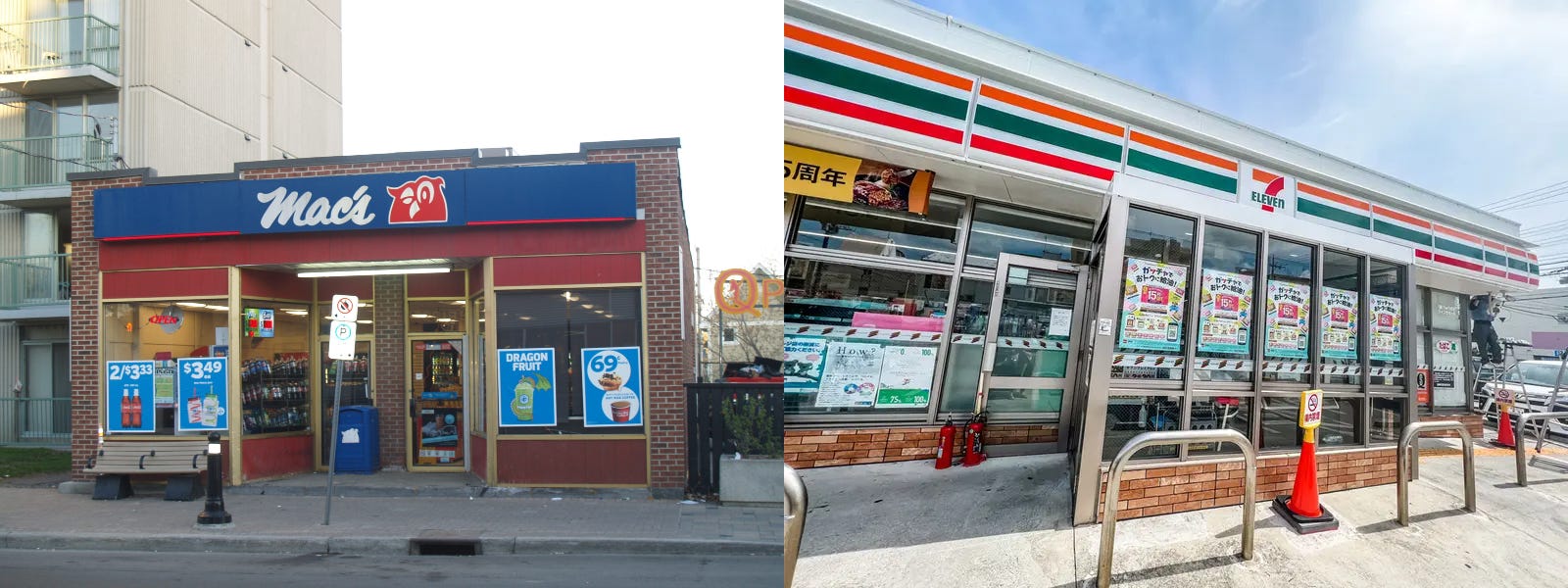
Parties to the Proposed Transaction
Purchaser: Alimentation Couche-Tard Inc (TSX : ATD)
Headquartered in Laval, QC, Alimentation Couche-Tard Inc has a significant footprint across North America, Europe, and parts of Asia, positioning it among the industry leaders. The company has grown through disciplined and strategic acquisitions, successfully integrating large portfolios of convenience retail and fuel assets, including the operations and assets of Circle K, Holiday Stationstores, and Ingo. Couche-Tard is known for its decentralized operating model and strong post-acquisition integration capabilities, positioning it as a credible acquirer in large-scale, cross-border transactions.
Couche-Tard’s recent acquisition of GetGo Café + Market not only strengthened its footprint in the United States but also signaled a strategic push into foodservice, which has been identified as a key growth opportunity within convenience retail, particularly in developed markets.
Target: Seven & I Holdings Co., Ltd (TYO: 3382)
Seven & i Holdings Co., Ltd is a Japan-based retail holding company whose core asset is the 7-Eleven brand, which has a global footprint of about 85,000 locations. Through decades of expansion and strategic acquisitions, particularly in the United States, the company has built one of the largest convenience store networks in the world.
In 2021, Seven & i Holdings completed the acquisition of the Speedway business from Marathon Petroleum Company, integrating more than 3,800 stores to its U.S. network, further reinforcing its scale in the North American market.
Timeline and Development of Discussions
Couche-Tard initiated discussions regarding the potential acquisition of Seven & i in August 2024, submitting a friendly, non-binding proposal to acquire all outstanding shares of Seven & i for $14.86 per share, valuing the company at approximately $38.6 billion. Couche-Tard indicated that the approach was intended to achieve a mutually beneficial transaction for the customers, employees, and other stakeholders of both businesses. Seven & i’s board and its special committee reviewed the initial proposal, concluding that it undervalued the company and did not adequately address strategic and regulatory considerations, though it remained opened to discussions.
Following the release of Seven & i’s comments, the company was reportedly re-classified as a ‘core’ business under Japan’s Foreign Exchange and Foreign Trade Act. This designation underscored the importance of national regulatory considerations in the transaction, reflecting the significance of Seven & i’s network to national infrastructure, municipal services and disaster relief.
As discussions progressed, Couche-Tard intensified its efforts, submitting a revised proposal of $18.19 per share, valuing Seven & i at approximately $47 billion and representing a premium of approximately 22% above the initial bid. To address public concerns regarding U.S. Federal Trade Commission (FTC) approval, Couche-Tard provided a term sheet in December 2024 that included a $1.2 billion reverse termination fee, increasing to $1.4 billion if required divestitures exceeded initial estimates. Despite these efforts, the parties remained at early-stage discussions without a binding agreement.
During this period, it was reported that members of the Ito family explored a management buyout (MBO), of which the offer to Seven & i was reportedly valued at approximately $58 billion. While the MBO ultimately failed to secure financing, its emergence resulted in Couche-Tard reaffirming its commitment to the transaction, notably by transitioning to a yen-denominated proposal based on its recently revised offer.
Shortly after a meeting in April 2025, the parties executed a non-disclosure agreement (NDA) that included a standstill provision, enabling limited due diligence to proceed. Couche-Tard indicated that access to more comprehensive information could allow it to further refine its proposal.
As engagement continued, the companies explored potential strategies to address U.S. antitrust hurdles, which were considered the primary obstacle given the overlapping convenience store footprint. Collaboration on this obstacle, included mapping potential divestitures of overlapping stores and evaluating alternative deal structures, including differentiated structuring among the domestic and international assets to be acquired.
On July 1, 2025, Seven & i proposed an alternative structure of the transaction through which it would contribute the 7-Eleven business to Couche-Tard in exchange for an equity stake. Couche-Tard rejected this proposal, citing concerns that it diluted the financial premium offered to the shareholders of Seven & i.
On July 16, 2025, Couche-Tard formally withdrew its proposal, in which its reasoning included, a lack of constructive engagement and limited access to meaningful due diligence information.
Why the Proposed Transaction Failed
Despite Couche-Tard’s sustained interest in acquiring Seven & i’s global operations and the Seven & i’s openness to dialogue, interrelated issues impeded progress toward full due diligence and a binding agreement. The collapse of the transaction was not attributable to a single factor but rather based on misalignment between the parties regarding regulatory risk allocation and valuation.
Regulatory uncertainty related to U.S. antitrust approval emerged as the primary hurdle. Given the significant overlap in the parties’ U.S. store footprints, Seven & i maintained that the scale of divestitures required by the Federal Trade Commission could reach an unprecedented level. Reportedly, involving a divestiture of up to 2,000 stores. Seven & i further indicated that Couche-Tard proposed an insufficient solution to address the unprecedented nature required for approval. Additionally, Seven & i indicated that it would be subject regulatory uncertainty regarding clearance for an extended period of time.
The second critical issue, tied to the first, was limited access to due diligence information. Seven & i limited access to its financial and operational data, citing unresolved regulatory concerns, the absence of a finalized transaction structure, and the competitive relationship existing between the parties. It is worth specifying that Couche-Tard proposed a transaction structure involving the acquisition of 100% of Seven & i’s international operations and 40% of its Japanese operations. However, the proposed structure failed to quell Seven & i’s concerns regarding regulatory risk, as the board remained wary of committing to a structure before antitrust outcomes were fully resolved. This proposal would have likely required substantial reliance on assumptions regarding future regulatory outcomes, which likely heightened concerns for Seven & i given the unprecedented nature of the transaction and the competitive overlap between the parties.
Additionally, it is important to note that while discussions with Couche-Tard were still ongoing, Seven & i announced plans to pursue an initial public offering of its North American operations targeted for the second half of 2026. This announcement signaled a strategic alternative to the full-sale transaction and underscored Seven & i’s focus on unlocking shareholder value independently.
The proposed listing likely reduced Seven & i’s urgency to accept a transaction structure that involved substantial regulatory uncertainty and loss of control, particularly given the antitrust complexities associated with a full acquisition by Couche-Tard.
These unresolved structural and diligence-related issues contributed to the breakdown in engagement between the two parties. Couche-Tard characterized the process as lacking sincere and constructive engagement, citing delay and obfuscation. Conversely, Seven & i’s special committee indicated that it had engaged in good faith throughout the discussions and had consistently communicated the extraordinary antitrust hurdles the transaction would face, including a prolonged and uncertain regulatory timeline. Seven & i emphasized that, despite collaborative efforts to explore divestiture strategies, the scale of required remedies would have been unprecedented in the industry.
Ultimately, the transaction failed because the parties were unable to align on a structure that adequately addressed regulatory risk while delivering acceptable certainty, control, and value for both sides. As the regulatory complexity persisted and engagement deteriorated, momentum stalled, leading Couche-Tard to formally withdraw its proposal.
Significance & Key Takeaways
Had the transaction closed, Alimentation Couche-Tard would have emerged as the global leader in the convenience store industry, significantly expanding its geographical footprint to more than 100,000 locations worldwide. The failure to close the deal underscores the complexity of large-scale, cross-border M&A, where regulatory hurdles and national economic priorities can materially influence outcomes.
More broadly, this case demonstrates that these external pressures can slow or halt transactions well before formal diligence begins. And thus, early alignment on control, deal structure, and governance is critical, as even substantial premiums may be insufficient to overcome regulatory friction.
Based on publicly available information as of February 2026 and does not constitute financial or legal advice.